Data stays in India
Mumbai database, Mumbai servers — DPDP Act 2023
One shop cannot see another
Enforced by the database, not just the app
HUID on every piece
Traceable from purchase to the customer's invoice
Paise-exact arithmetic
One rounding, at the end — reports agree to the rupee
Why jewellers change systems
The stock is worth crores. The record of it is a desktop package and four spreadsheets.
Nobody can say what is where
Counts by category instead of by piece. A weight that disagrees between the counter, the karigar register and the books — and no way to prove which is right.
Compliance bolted on afterwards
HUID kept in a separate file, e-invoices raised by hand, GST split worked out on a calculator. Every one of them a notice waiting to happen.
The owner is the last to know
Yesterday's figures, if any. No view across branches without a phone call to each manager, and nothing at all on a phone.
The product
Screens your counter staff will use on day one
Not a mock-up. These are the real screens, with real arithmetic — every figure below was computed by the software itself.
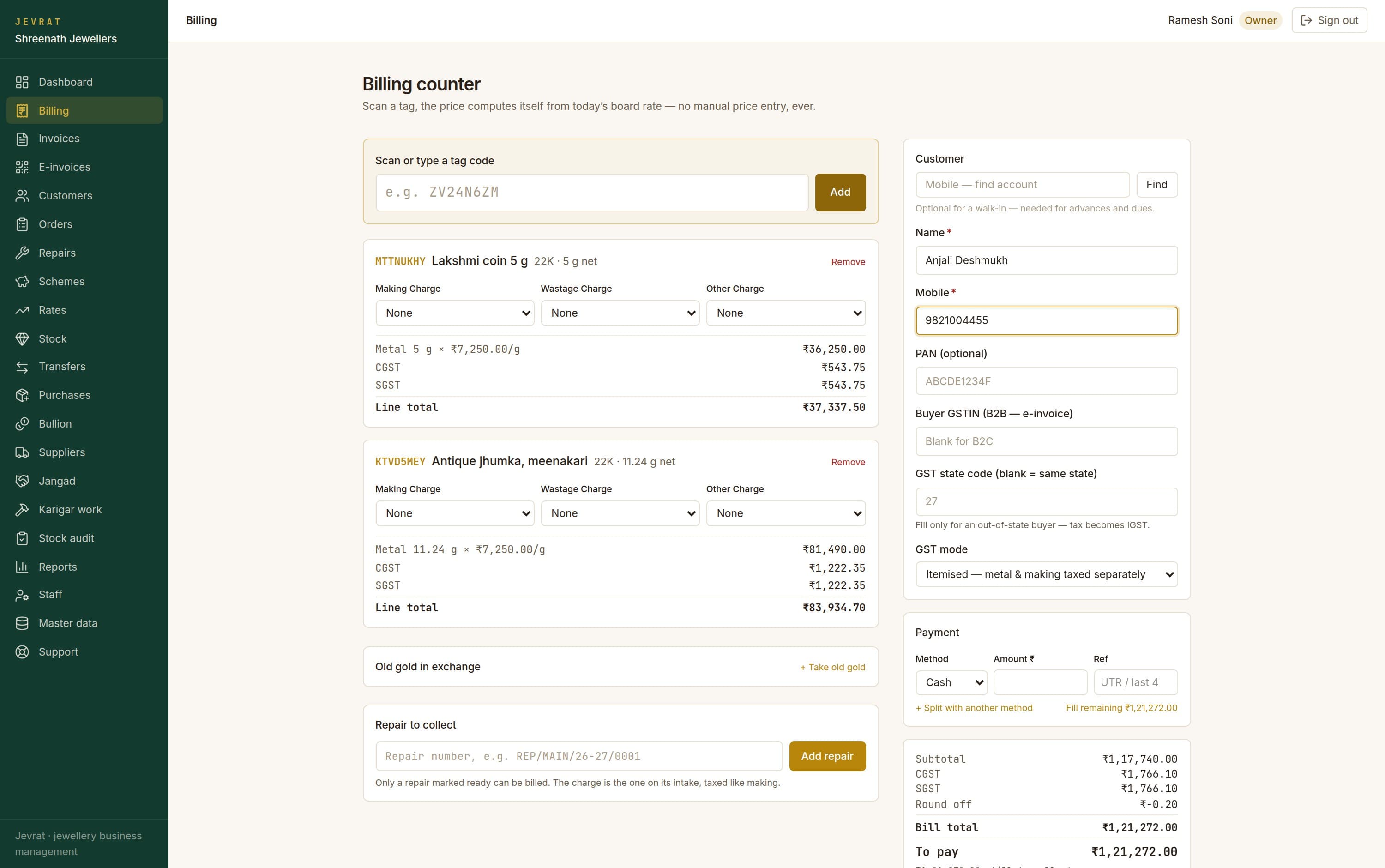
Scan the tag. The price is already right.
Net weight × today’s board rate, plus the making rule for that category — computed as the piece lands on the bill. Old gold comes in on the same invoice, payment splits across cash, card and UPI, and the GST is itemised so metal and making carry their own rates.
No price list to maintain. No arithmetic at the counter. No argument at the till.
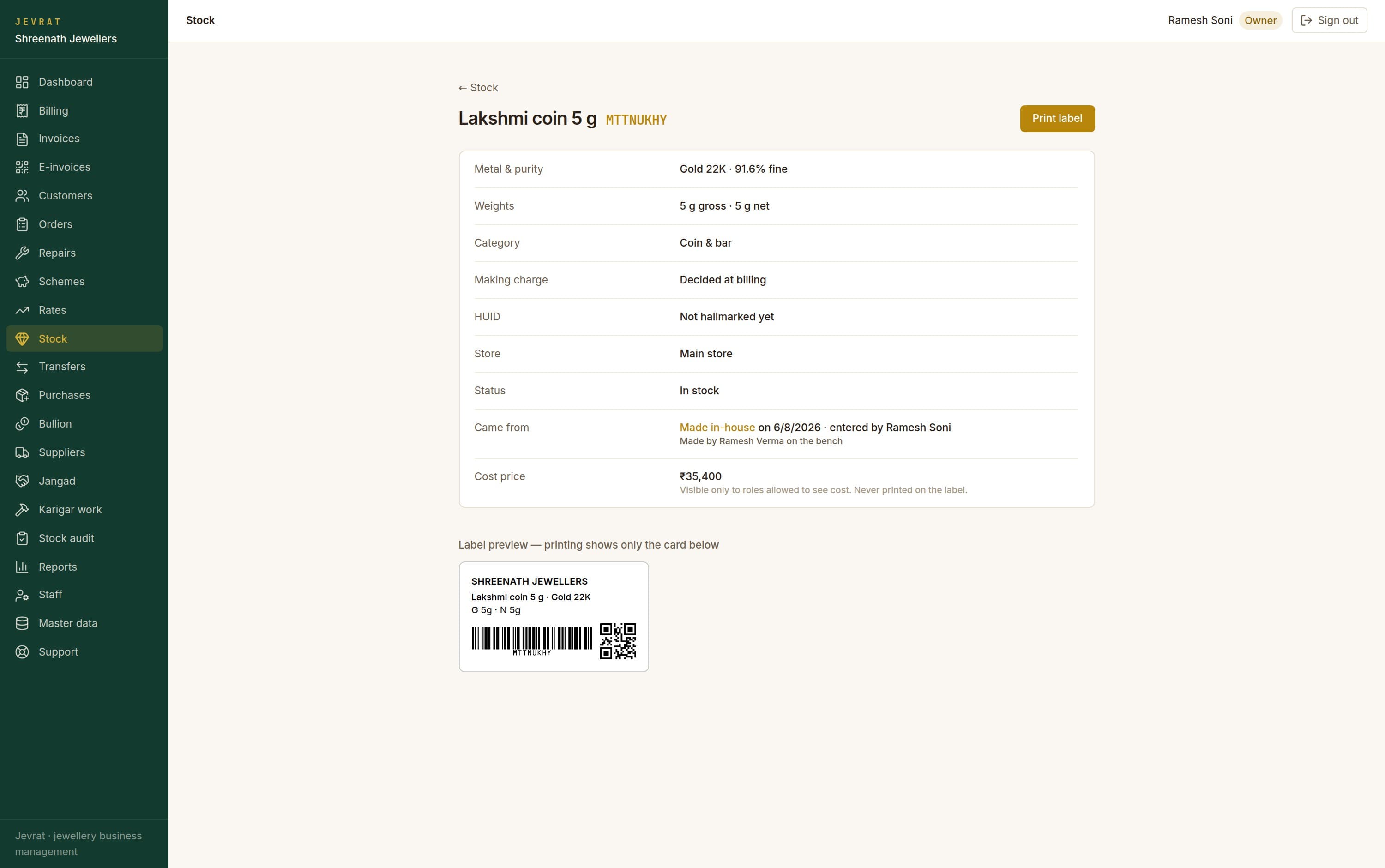
Every piece is a record, not a number in a column
Each item carries its own code, barcode and QR, its gross and net weight, purity, category, HUID, the store it sits in, and where it came from — a supplier delivery or your own bench. Cost price is shown only to the people allowed to see it, and never printed on the label.
When an auditor asks where a piece is, there is one answer.
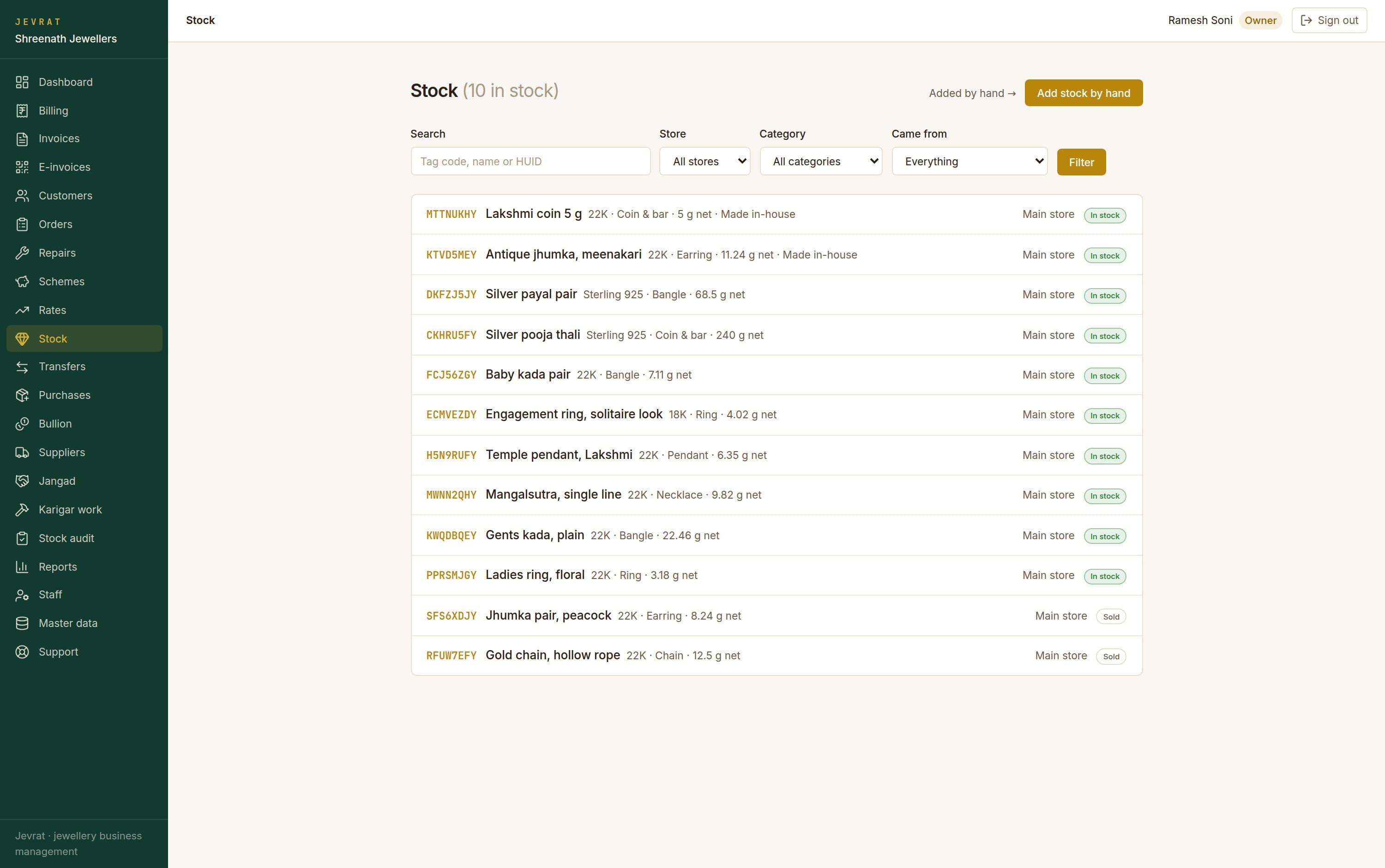
Count a store without closing it for a week
Freeze a store, scan its pieces, and get a variance report that names every item found, missing or in the wrong place. Adjustments need a second person to approve them, and the whole trail is kept.
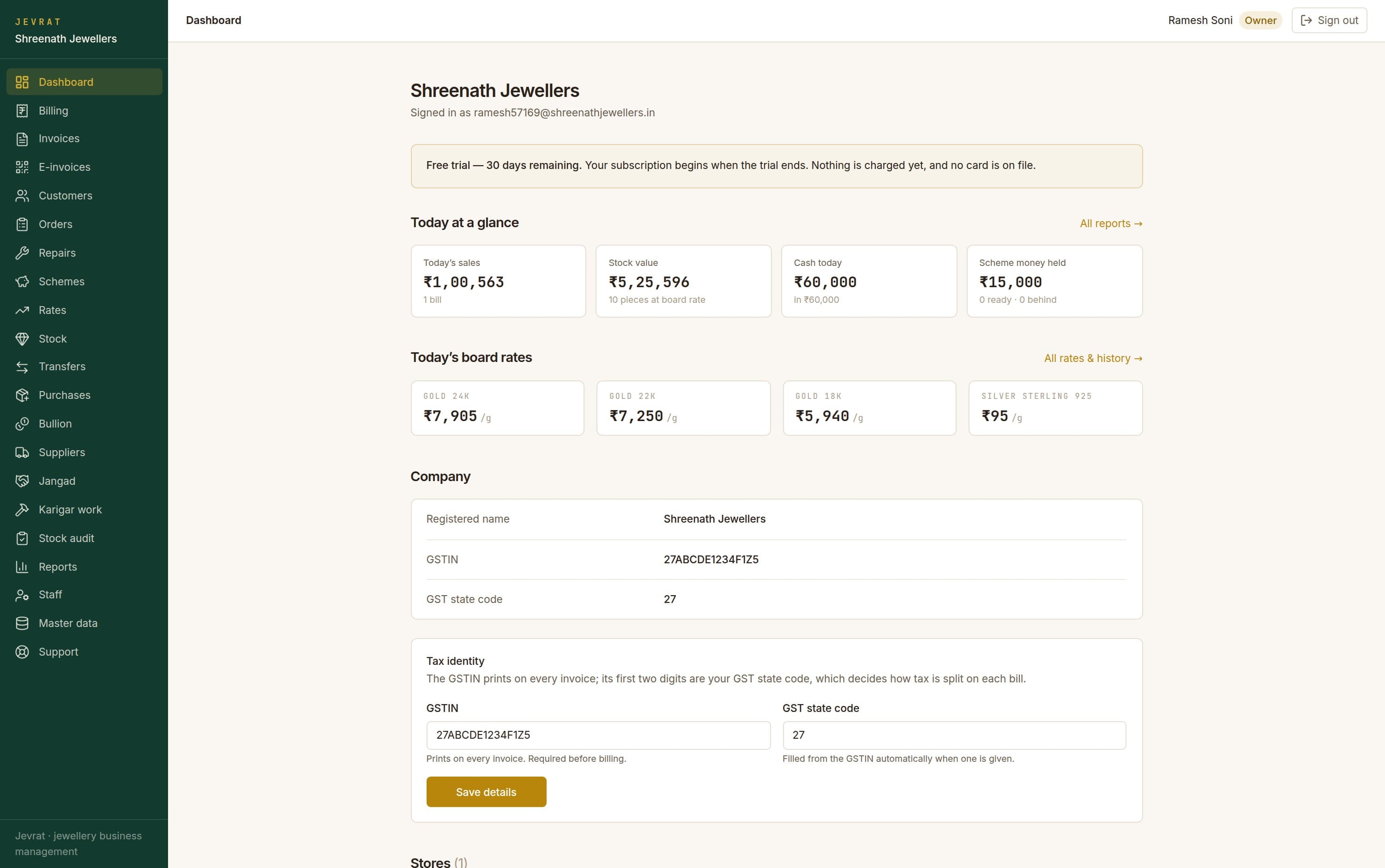
The whole chain, on the phone in your pocket
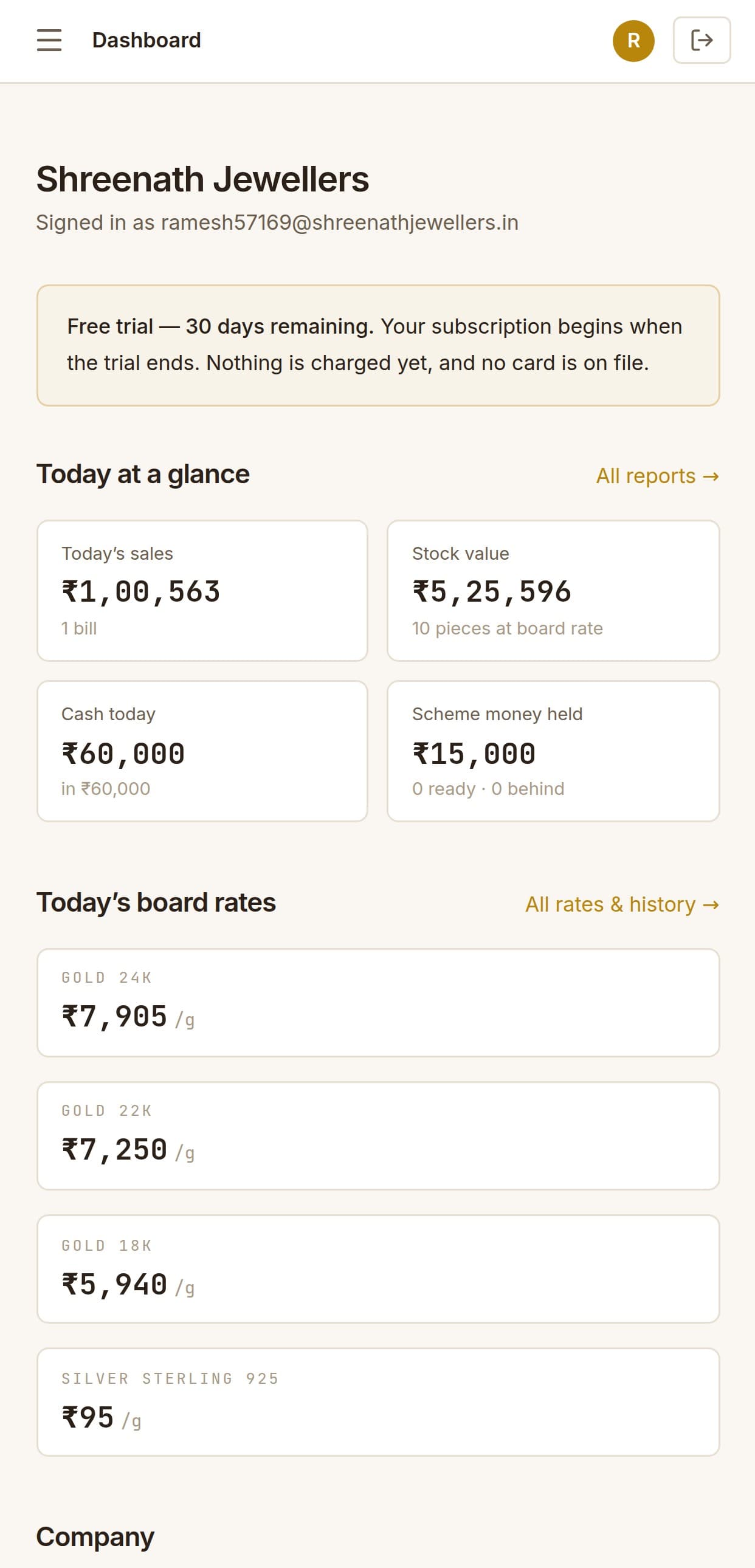
Today’s sales, stock value at today’s board rate, cash taken, and scheme money held — per store or across all of them. Built phone-first, because that is where owners actually look.
What it covers
Metal to money, factory to counter to the customer’s phone
One system, deeply configured — rather than a general retail package with jewellery bolted onto the side.
Tag-level stock
Every piece gets its own tag the moment it arrives — code, barcode, QR, weights, purity, HUID and cost. Never a vague count of “22K bangles”.
Rates and pricing
Publish the board rate once a day. Every piece then prices itself from its net weight, with making, wastage and other charges by your own rules.
The billing counter
Scan a tag, take old gold in exchange, split the payment, issue the invoice. Built for festival crowds and a shaky connection.
GST and e-invoicing
Metal and making taxed separately at 3% and 5%, every computation shown. B2B bills registered with the government portal, with IRN and QR printed.
Karigar job work
Issue metal, track wastage against tolerance, and settle each karigar in grams and rupees side by side. Records kept the way ITC-04 expects.
Savings schemes
Enrol a customer, collect instalments, run the passbook, and redeem at the counter with the bonus applied — without a single parallel register.
Customers and WhatsApp
One page per customer: purchases, advances, dues, schemes, repairs and orders. Send the invoice or a scheme reminder to their phone.
Every showroom
Stock, staff and rates per store, transfers on a challan, and a head-office view over all of them — with a stock count that freezes a store to scan it.
Reports that tie out
Sales, stock position, dues, GST, karigar and schemes — each re-derived from the records themselves, so the figures agree with the books.
Getting started
Live in weeks, not quarters
We load your stock
Piece by piece or in bulk, with weights, purity, HUID and cost intact. You get printed tags at the end of it, and a stock value you can check.
You publish today's rate
One number per purity, each morning. From that moment the counter prices itself and nobody types an amount by hand again.
You bill, and watch
Staff sell; you see the day's sales, stock value and cash on your phone from wherever you are. Run in parallel with your old system as long as you like.
Questions
What jewellers ask us first
Something not answered here? Ask us directly — a person replies, not a form letter.
What is Jevrat?
Jevrat is cloud jewellery business management software for Indian jewellers. It covers tag-level stock, a billing counter that prices each piece from the day's board rate, old-gold exchange, karigar job work, savings schemes, customer records with WhatsApp, GST invoicing with e-invoice registration, and reporting across every showroom — in one system rather than a desktop package plus spreadsheets.
Does Jevrat handle GST and e-invoicing for jewellery?
Yes. Every bill splits metal and making so the 3% and 5% GST rates apply to the right amounts, and the invoice shows the full computation. B2B bills with a buyer GSTIN are registered with the government's e-invoice portal and print the IRN, acknowledgement number and QR code. If the portal is down the sale still completes and registration is retried automatically.
How does pricing from the daily gold rate work?
You publish the board rate for each purity once a day. From then on, scanning a tag prices the piece from that rate and its net weight — nobody types a price at the counter. Making charges, wastage and other charges follow the rules you set per category, and every line on the invoice shows how it was worked out.
Does it support HUID hallmarking records?
Yes. Each piece carries its own tag with a unique code, barcode and QR, and its HUID is recorded against it so the hallmark can be traced from purchase through to the customer's invoice.
Can it run several showrooms?
Yes. Stock, staff, rates and reports are per store, with transfers between stores on a challan, and a head-office view across all of them. Owners get a phone-first dashboard showing the day's sales, stock value and cash across the chain.
Where is our data stored?
In India. The database is hosted in Mumbai and every server function runs in the Mumbai region, which is what the Digital Personal Data Protection Act 2023 expects of customer records. One shop's records are isolated from another's in the database itself, not merely in the application.
What does it cost?
Plans are billed per month or per year and are sized by the number of showrooms and staff accounts, with savings schemes and WhatsApp messaging available on the larger plans. There is a free trial and no card is needed to start. Ask us for current pricing for your chain.
Can we move our existing data across?
Yes. Opening stock can be entered piece by piece or in bulk, and each piece keeps its own weights, purity, HUID and cost. We help with the first load and run in parallel with your existing system for as long as you want the reassurance.
Book a demo
See it with your own stock
Half an hour, on a call, with your own pieces and your own rates — not a canned demo. Tell us a little and we will arrange it.
- A working walkthrough of the counter, stock and reports
- An honest answer on whether it fits how you run today
- What moving your existing stock across actually involves
Prefer to write? Use the contact page